What Is 3-Phase Power and Do I Need It for My Home?
Over the past decade, homes have become much more reliant on technology. Large ducted air conditioners, electric ovens, EV chargers, and home workshop equipment all place greater demands on electricity.
The problem? Many older Melbourne homes weren’t designed to handle that kind of load. That’s why more homeowners are upgrading from single-phase to 3-phase power.
In this guide, we’ll explain what 3-phase power is, how it compares to a standard power supply, and when it might be time to consider an upgrade for your home.
What Is 3-Phase Power?
Single-phase power uses one active wire and one neutral wire to deliver 230 volts. That’s usually enough to run your everyday appliances like televisions, fridges, and lighting.
But if you’re using high-demand appliances like a large air conditioning system, an electric cooktop, or an EV charger, you might start noticing flickering lights, circuit breakers tripping, or appliances not performing as they should. That’s often a sign your current setup is being pushed too hard.
3-phase power uses three active wires and one neutral wire to deliver 415 volts. Think of it like upgrading from a single-lane road to a three-lane highway. It allows more electricity to flow to your home with greater efficiency and stability.
For a deeper dive into how it compares to standard power, check out our blog post on single-phase vs. three-phase power.
Single-Phase vs. 3-Phase: What’s the Difference?
Feature: Voltage
- Single-phase: 230V
- Three-phase: 415V
Feature: Load capacity
- Single-phase: Lower
- Three-phase: Higher
Feature: Appliance support
- Single-phase: Standard household appliances
- Three-phase: High-demand appliances
Feature: Best for
- Single-phase: Small to medium homes
- Three-phase: Larger or modern homes

When Should You Consider 3-Phase Power in Melbourne?
Most average-sized homes in Melbourne can run comfortably on a single-phase supply. However, some households may benefit from upgrading if their power needs exceed the standard limits.
You may want to consider 3-phase power if:
You’re building or renovating a large home with multiple circuits, larger HVAC systems, or electric water heaters
You plan to install an instantaneous electric hot water system, which requires more energy than traditional systems
You’re installing a fast EV charger that requires more power than a single-phase supply can provide
You use industrial-grade tools or machinery at home, such as in a workshop or home business
You’re adding a large solar PV system with battery storage
Frequent circuit trips, flickering lights, or ongoing voltage issues can also signal the need for an upgrade. To learn more about what's involved in upgrading, take a look at our residential supply upgrades page.
How Do You Know If You Already Have 3-Phase Power?
Not sure what kind of power setup your home has? Here’s how to find out:
Check your switchboard: If you see three main switches or one wide switch, there’s a good chance you have 3-phase power
Look for labels: Your meter or board might be marked with “3-phase,” “tri-phase,” or “four-wire”
Contact your energy distributor: United Energy, CitiPower, Jemena, or AusNet can confirm your supply over the phone
Book a free inspection: Our team can take a look and let you know exactly what you’re working with.
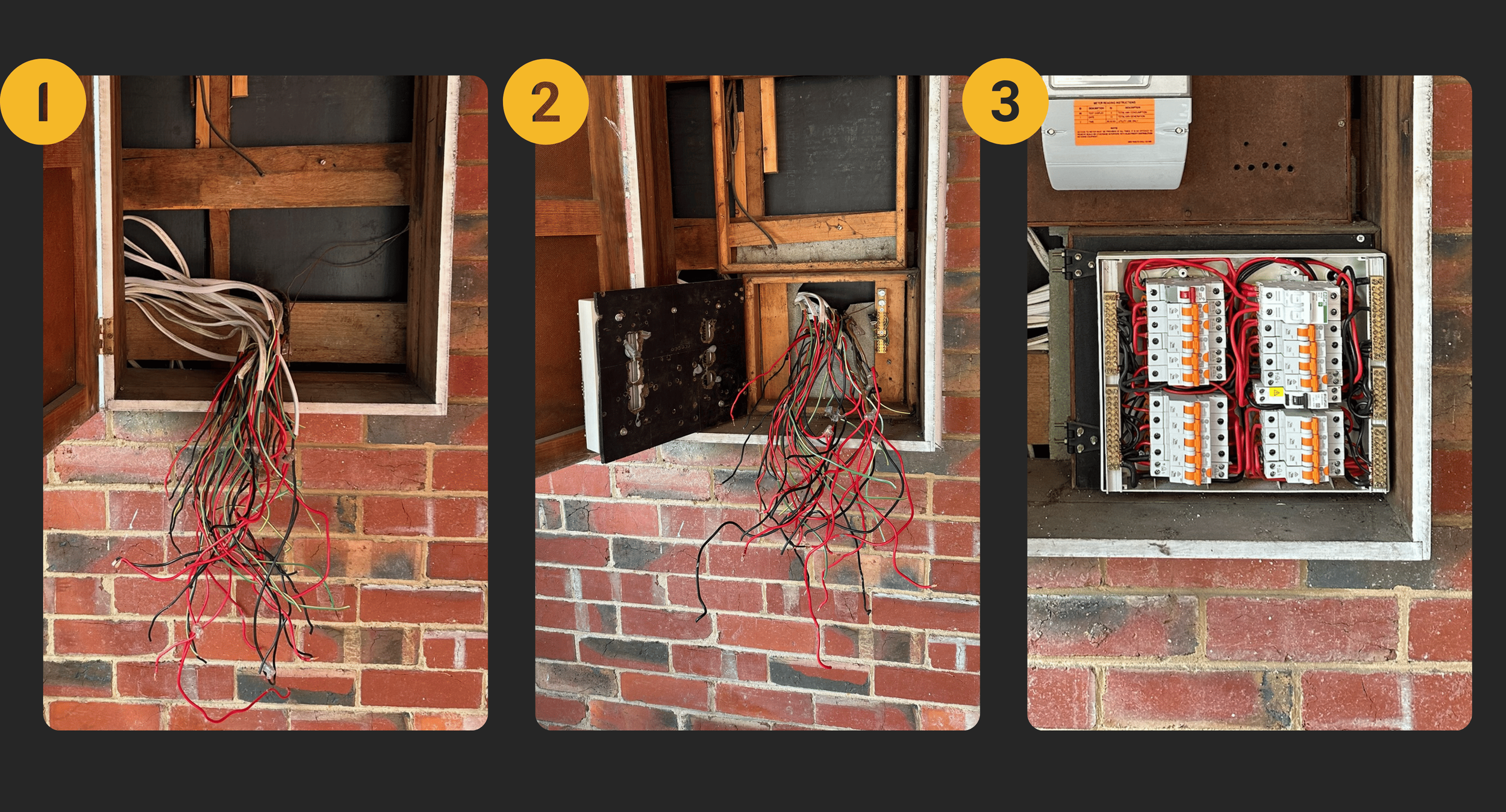
How Much Does a 3-Phase Power Upgrade Cost in Melbourne?
For most Melbourne homes, a 3-phase power upgrade typically costs between $5,000 and $8,000. That said, a few things can affect the final cost:
Distance from the street: The further your home is from the mains, the more materials and labour are required
Switchboard upgrades: Older boards may need to be replaced to meet current safety standards
Rewiring: If your home’s wiring isn’t rated for 3-phase, it will need updating
Additional circuits: High-powered appliances like EV chargers may require dedicated circuits
We break down the whole process on our Mains Power Upgrade Melbourne page.
The best way to get a solid quote is to book a free home inspection. We’ll check your current setup and give you a clear, honest estimate with no surprises.
Why More Melbourne Homes Are Upgrading to 3-Phase Power
The biggest reason is increased energy use.
Modern appliances and smart technology draw more power than older models. An instantaneous hot water system, for example, can draw up to 18,000 watts, while older systems used about 3,000 to 4,500 watts. Add in bigger TVs, dishwashers, smart lighting, and home office gear, and your single-phase system may start to feel the strain.
Solar power and EVs are also becoming more popular across Melbourne. A 3-phase setup can help manage and export solar energy more efficiently while also charging electric vehicles faster.
In fact, a recent CSIRO study found that households could save thousands over time by switching to electric appliances, especially when powered by rooftop solar. For many homeowners, upgrading to 3-phase power is an important step in making that transition smooth and future-ready.
If you’re considering an all-electric home, the Victorian Government’s Power Up Your Home guide is another useful resource.

Why Choose AJD Electrical Solutions for Your Upgrade?
We’ve been helping Melbourne homeowners upgrade to 3-phase power for over 10 years. Our reputation is built on quality work, fair pricing, and reliable service.
Here’s what you can expect when you work with us:
Over a decade of experience
Hundreds of 3-phase upgrades completed across Melbourne
More than 100 five-star reviews from happy clients
Fully licensed, insured, and Energy Safe Victoria accredited
Honest, transparent pricing with no hidden fees
Clean, professional service that respects your spac
End-to-end project management so you don’t have to stress about a thing
Ready to Discuss a 3-Phase Power Upgrade?
Not sure if your home needs 3-phase power or a supply upgrade? Speak with a licensed electrician in Box Hill to book a free assessment and get clear advice tailored to your property and power needs.
We regularly carry out three-phase upgrades across Melbourne suburbs such as Box Hill, Surrey Hills, and Doncaster.
Frequently Asked Questions About 3-Phase Power
-
Single-phase power uses one active wire and supplies 230 volts, which is suitable for most standard household appliances. Three-phase power uses three active wires and delivers 415 volts, allowing your home to handle higher electrical loads more efficiently. Three-phase power provides better stability and reduces the risk of circuit overloads when running high-demand equipment.
-
Three-phase power is worth considering if your home uses high-demand appliances such as ducted air conditioning, electric vehicle chargers, induction cooktops, or instantaneous hot water systems. While not every household needs it, many Melbourne homeowners upgrade to three-phase to future-proof their electrical supply and avoid ongoing power issues.
-
Yes, most Melbourne homes can be upgraded from single-phase to three-phase power. The process usually involves coordination with your energy distributor, upgrades to your switchboard, and sometimes new cabling from the street. A licensed electrician can assess whether your home is suitable and manage the entire upgrade process.
-
Signs that your home may need a power upgrade include frequent circuit breaker trips, flickering lights, limited capacity for new appliances, or difficulty running multiple high-powered devices at once. Older Melbourne homes are especially prone to these issues as modern electrical demands are much higher than when they were built.
-
Three-phase power does not usually increase your electricity bills on its own. In many cases, it can actually be more efficient when running high-powered appliances because the electrical load is distributed more evenly. The main cost is the upfront installation rather than ongoing usage.
-
In Melbourne, a typical three-phase power upgrade usually costs between $5,000 and $8,000. The final price depends on factors such as your distance from the street mains, whether your switchboard needs replacing, and how much rewiring is required. A site inspection is the best way to get an accurate quote.
-
Not always. Standard EV chargers can run on single-phase power, but charging speeds are slower. If you want faster charging, plan to install a higher-capacity charger, or expect to charge multiple electric vehicles, three-phase power is usually the better long-term option.
-
Yes, upgrading to three-phase power requires approval from your local energy distributor. Your electrician will handle the application process, coordinate inspections, and ensure the upgrade complies with Victorian safety and electrical regulations.